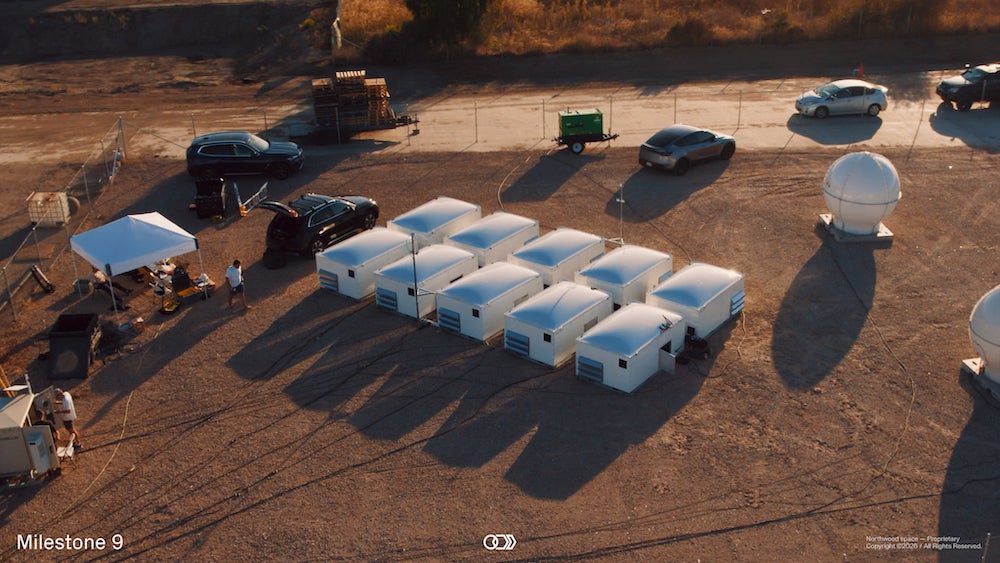
Northwood Space said it has demonstrated full-duplex contacts with a government satellite in Geosynchronous Orbit (GEO) using a company-developed ground-based antenna, a key milestone for the company’s technology that showcased how government operators can leverage commercial antenna capacity.
The contacts with Northwood’s Portal phased array antenna was performed through a prototype contract with the Space Force’s Space Systems Command’s Program Acquisition Executive for Battle Management Command, Control, Communications and Space Intelligence. The milestone was achieved within a year of award.
Previously, Northwood demonstrated full-duplex communications with a satellite in Low Earth Orbit (LEO). Full-duplex refers to simultaneous use of the antenna to send commands to the satellite and receive data over the same link.
“A single aperture doing simultaneous transmit and receive is hard to pull off, and it shows a commercial phased array can handle real operational satellite control,” the company said.
Use of the telemetry, tracking and control link was done through the Space Force’s Joint Antenna Marketplace (JAM), where government operators can access commercial capacity to meet demand. Northwood said the September demonstration was a first for JAM in its integration and use by operators of a commercial phased array.
Northwood is creating a network of arrays to give customers more options for government, commercial and allied operators.
“Our thesis is that when ground access is dependable, and you can add capacity where and when you need it without overbuilding, operators can start asking what new things they can do: different kinds of links, more satellites, richer data, new kinds of missions. JAM will be one way to reach that network, but not the only way,” the company said.
Full-duplex contact with the GEO satellite was the final milestone in the prototype contract, making Northwood eligible for program offices to negotiate production agreements with the company for the capability without having to establish a new contract based on Federal Acquisition Regulations, the company said.