
BREMEN, Germany — European tech leaders did not mince words about the sovereignty challenge and the risks if left unchecked during the last day of Space Tech Expo Europe.
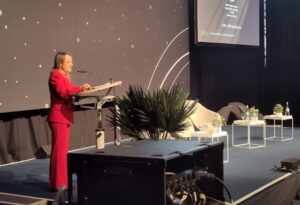
“Today we are imagining crises like sudden import restrictions, as we already see today in GPUs. Today 96% are imported. All our European space players compute with foreign chipsets,” Justyna Redelkiewicz, senior partner at Polish tech consulting firm 3 Hazel Tree Partners said. “The dominance of ASML [Dutch semiconductor manufacturer] was built over decades. With a long-term and persistent strategy, we can replicate that kind of leadership elsewhere.”
Egbert Van Der Veen, head of business & corporate development at Germany’s DSI Aerospace, pointed to his company’s heavy use of chip manufacturer AMD, for which there is “no European alternative right now.”
There is an increased need advanced components, which puts pressure on unforgiving geopolitical trends.
“Space is becoming less and less civilian and more dual-use,” explained Benjamin Kawak, vice president of sales & growth at Atmos Space Cargo. “That makes dependency beyond Europe more critical. We might be locating a cost advantage in these cases, but dependency will always have its own costs in the end.”
While optimistic about the solutions, there was no shortage of European sobriety about the nature of the danger present.
“Just 150 satellites were launched inside Europe this year,” Redelkiewicz said. “That scale doesn’t match our ambition. Another sovereignty hurdle is that despite these goals, companies keep selling to foreign buyers. These innovators are something we ought to think about protecting.”
Augustinas Lubys, director of business development at small satellite bus manufacturer NanoAvionics, spoke similarly.
“Europe still depends on non-European providers across several critical parts of the space value chain,” he said. “However, that is changing. Strategic autonomy does not require Europe to produce everything independently, but it does require control over critical capabilities and access to trusted supply chains.”
Supply Must Follow Demand
Experts on the panel agreed that locating and working on demand bases is how Europe will scale its own sovereign industrial winners.
“Where there was demand, we could achieve European success stories, as was the case in the automotive industry, for a time,” Redelkiewicz recalled. “In space, we have European integrators and native demand, so it’s possible to generate the demand to scale, but it’s all about quantity. When we can be profitable at thousand-unit levels, Europe can succeed.”
While Van Der Veen agreed it is critical to develop native solutions that are “at least on par” with what can be found on the world market, the demand market for electronics in Europe is small, and would require global scale to grow.
Europe’s closer allies in NATO have been exploring designs to sell their own technology into a continent looking to reindustrialize and rearm.
“If we can create a bigger demand base with the help of nations like Britain, Canada, or even Australia, it’s much more feasible to come to a solution together,” Van Der Veen said. “We may need to align better to make that happen.”
Redelkiewicz acknowledged the existing political burden of dealing with the European Union’s own member states, let alone nations outside of it.
“Each state wants its own satellites, and will fight to divide shared infrastructures, which is a huge risk, she said.”
The Investment Question
Many at home and abroad have been curious about how Europe will fund targeted increases in space programs and space industrial capacity.
“In space, at least a couple of years ago, it was possible to get European funding up to Series A; then Series B would become dominated by the U.S.,” Redelkiewicz explained. “Today, up to Series C, Europe can handle it natively, but there are still sovereign investment issues. There’s a positive feedback loop here, but it takes time to mature.”
Atmos’ Kawak wasn’t convinced about Europe’s capacity to attract overseas capital to leverage for its own ends.
“I don’t believe Europe has open doors to investment outside the continent,” he said. “Which is an issue, because Europe doesn’t have the private capital to build out a formidable space economy natively. One part of the solution is about public investment, another is selling at premiums instead of getting into a race to the bottom on price.”
Despite a clear focus on the myriad risks and obstacles Europe faces, the panel was united in a vision of European success.
“Europe needs consistency in its strategy, and not to lose hope,” Redelkiewicz said. “We are a 500 million-strong region. Europe is not negligible. With persistence, she can succeed.”