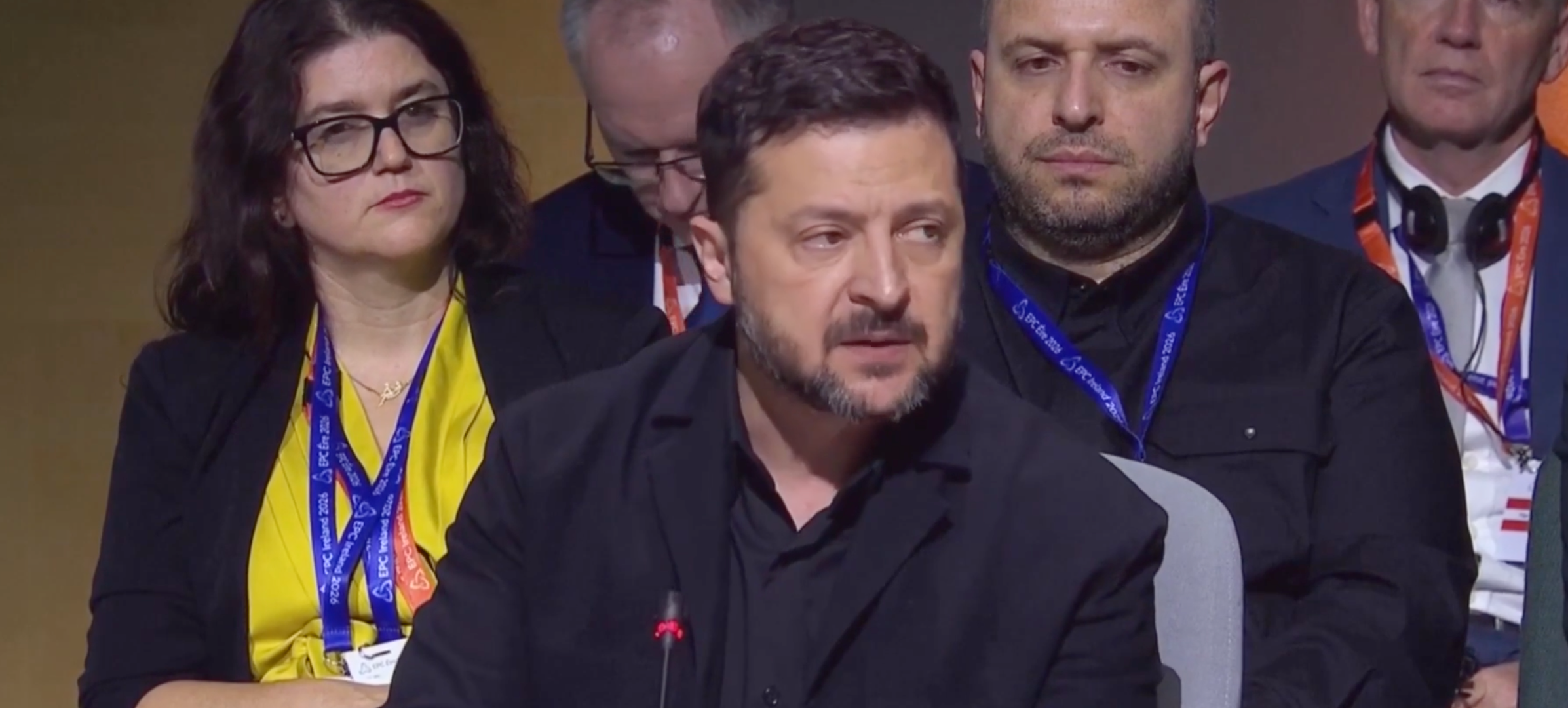
Ukrainian President Volodymyr Zelenskyy reported more restrictions to Ukraine’s Starshield access, telling European leaders that the service is limited on terminals in motion to 100 miles per hour.
This slowdown impacts Ukraine’s ability to intercept Russian jet-powered drones, Zelenskyy said Thursday at the 9th European Political Community Summit in Ireland.
“Because of the speed restrictions, we simply cannot catch up with [Shahed drones] in time. Near the frontline, we cannot use our aircraft. Only drone interceptors can operate there. And without the speed we need, shooting down these ‘Shaheds’ becomes much harder,” Zelenskyy said. “This means more Russian strikes get through, and more of our people are killed by Russia.”
Zelenskyy said that Ukraine is working to get information from the U.S. on the disruptions. He also stated that the Ukrainian military has investigated the circumstances and determined they are “not random errors but systematic speed restrictions.”
This comes after Ukrainian forces experienced a similar slowdown last month, putting Ukraine’s access to satellite communications at the center of international news.
Last month, SpaceX founder and CEO Elon Musk responded by saying that any restrictions on the Starshield, the government variant of Starlink, are determined by the U.S. government and the president. However, Musk later stated that SpaceX did restrict Ukraine’s use of commercial Starlink service for violating its service terms and using it for offensive strikes.
Lawmakers on both sides of the aisle in the U.S. have called for investigations into the decisions. Republican Congressman Michael McCaul, R-Texas, spoke out in a Thursday statement that he is “deeply concerned” by the reports and called for a full investigation into the disruptions.
In addition, a bipartisan group of nine senators called for an investigation by the Department of Defense (DoD) last month.
In the satellite industry, it has renewed calls for alternatives to Starlink and greater European sovereign control over certain communications capabilities.
Novaspace CEO and industry analyst Pacôme Révillon said these disruptions have put additional light on the issue, which has been known and ongoing for two to three years. Speaking on a Via Satellite webinar on Wednesday, Révillon noted that Starlink has been a key enabler for Ukrainian forces throughout the war, but it’s not ideal to be “fully dependent on a single source that you cannot control” for certain use cases.
“Part of the solution may come from IRIS² within a few years, part of the solution may come from additional sovereign constellation programs within several years. A piece of the answer may also be from commercial suppliers as an augmentation or diversity option,” Révillon said. “When is there going to be actual choice or diversity for certain capabilities? It’s getting closer, but it’s not there yet.”
The recent disruptions spurred at least one new partnership in Europe between Finnish company Iceye and Nokia, which recently announced a plan to develop a satcom capability for Ukraine, signing a letter of intent with the Ministry of Defence of Ukraine. Iceye CEO Rafal Modrzewski said last month that “Ukraine needs secure, sovereign and high-performance satellite communications systems that it controls.”
Rafel Jorda Siquier, CEO and founder of British satellite company Open Cosmos, argued that the on-off switch for these capabilities cannot be “outside the control of those relying on it.”
“Europe needs sovereign, interoperable satellite communications and Earth observation capabilities that provide resilience, operational independence and assured access when it matters most,” Siquier said in a Thursday statement. “This is not about superseding international partners, but ensuring Europe has the capacity to act independently when required, as well as to work seamlessly with allied systems. These developments reinforce the urgency of calls across Europe and the UK to deliver highly assured satellite services under our own control.”