
Debates around spectrum allocation in Europe are heating up as regulators approach big decisions on the topic at upcoming summits. After a spate of spectrum deals around the world in the last 12 months, one Eutelsat executive remarked that verticalization pushes are part of the very same trend.
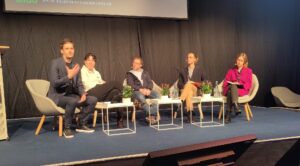
“Spectrum is power,” said Etienne Lesoeur, international affairs director at Eutelsat, at a Space Tech Expo Europe panel last week “The acquisition of Iridium by Rocket Lab showcased that having priority above other services in the right frequencies is key if you want to compete in this market. That’s why we did the merger with OneWeb; it had priority filings above Starlink. It was more strategic for us to buy the [OneWeb] constellation than create our own and have to begin a similar filing process.”
Lesoeur went on to say that major players are taking position in the Low-Earth Orbit (LEO) market, and that there are a limited number of seats in that space.
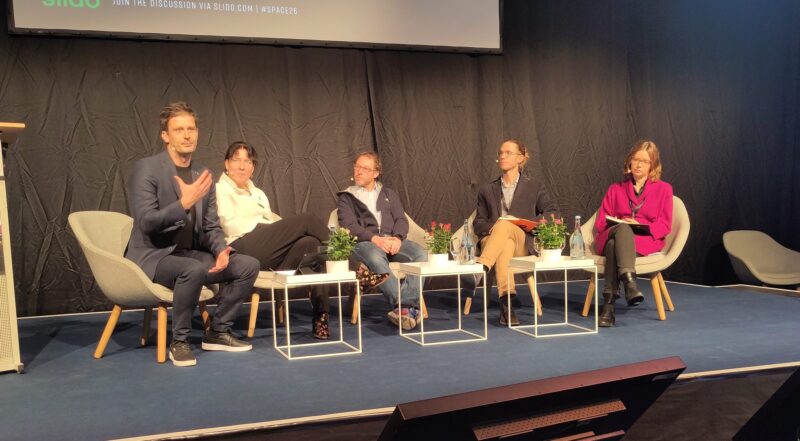
Speculating on strategic use of spectrum earlier that day, a satellite systems engineer suggested how companies may seize certain efficiencies with limited wavelengths.
“If you’re into mass market, D2D services, you’ll need the spectrum to deliver that,” Andy Walker, head of satellite and space at technology and product development group TTP plc told Via Satellite. “When you start to think about different use cases, which are perhaps not as high from a volume perspective, you may be able to take a cleverer route, using cheaper spectrum to do more with less.”
In Europe’s upcoming 2 GHz proceeding, the EU Commission decided that the spectrum be split into thirds, with one dedicated to an EU operator for government, security, and military to be integrated with the IRIS² program, and the other two thirds for commercial use, equally divided between new EU operators and EU and non-EU operators.
A department head at the German Aerospace Centre (DLR) on the panel suggested arrangements from prior years suffered from too much fragmentation.
“There was no common understanding on specific technical items,” explained Sandro Scalise, head of the satellite networks department at the DLR. “Back then there was no D2D or NTN, but there was complimentary run component, which wasn’t defined precisely, and administrations all understood the term to mean different things.”
The new proposal defines European operators, though whether this refers to a purism for those based on the continent itself or those willing to build operations there may be up to interpretation.
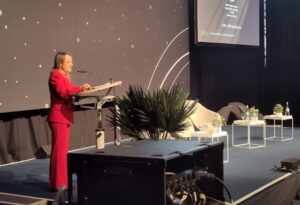
That same day, Maria Fernández Molinero, head of unit for Space Policy, at the European Commission said in a keynote address that Europe does not seek to discriminate for European companies above those bringing businesses from overseas.
A New Constellation for D2D
With so much spectrum seemingly earmarked for large EU projects, the panel turned to talk of a new Europe-wide constellation for direct-to-device connectivity.
“If we think of something in the range of 500-600 [satellites], the usual size to start something meaningful, you would have the capacity to offer a service complimentary to [existing terrestrial networks],” said Scalise. “Hundreds more satellites than this [running into the mid thousands] runs the danger of being unrealistic.”
Just the day before, Scalise remarked that Europe could likely only afford one D2D constellation.
The undertaking has gained momentum since four European telcos joined forces to seek to build a shared platform for D2D access in Europe. One of the four, Deutsche Telekom was present at the panel.
“We want to take our business and help to accelerate the development of a European D2D constellation,” said Jan-Hendrik Jochum, vice president of spectrum and satellite policy at Deutsche Telekom. “With a suitable satellite partner, we can help this ecosystem grow in a competitive way. At the moment, there’s only one potential provider [in Starlink] which isn’t a situation we want to cement for the future.”
Jochum also had criticism for the regulatory environment.
“It should not be up to regulation to push industry anywhere, they should be looking to enable,” Jochum said. “This sets the right mood. To define by regulation has not worked out well when it’s been tried, is my feeling. … As a mobile operator, it often looks like we have old-world regulation that has difficulty applying itself effectively to the new world.”